





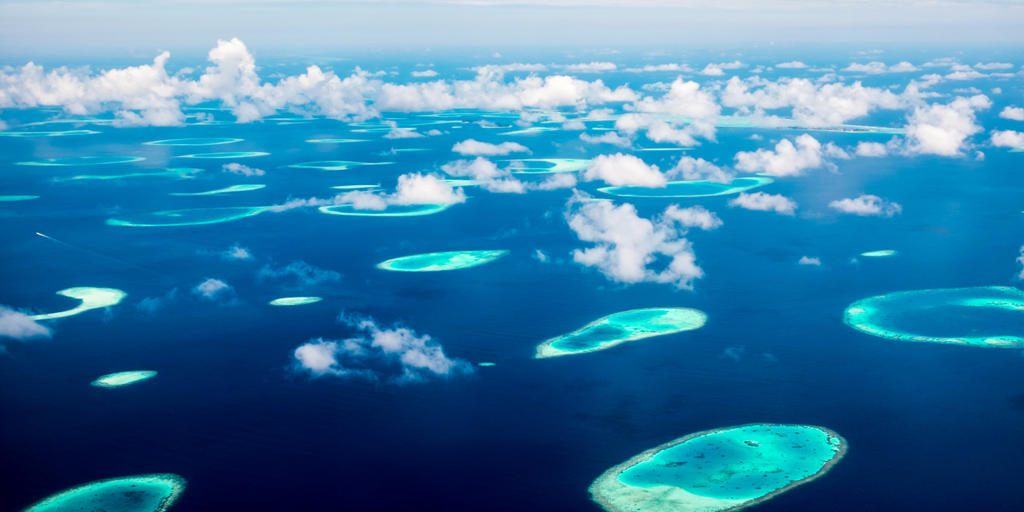
The rise of sea-levels has been a concerning and severe threat for low-lying coral reef nations such as the Maldives.
It has been the conjecture that invasive waters will affect all reef islands the same, with many submerging under the waves. Contrary to this belief, proof has transpired that islands are formed according to their reef environments and are different and some may even grow, as the water level increases.
The latest evidence is spawned from research done on the Maldives. The research team operated at two sites in Huvadhoo Atoll, one at the southwestern side and another at the northeastern side of the atoll. To understand the formation and history of the reefs the scientists used different tools and techniques such as topographic surveys using laser levels, the examination of subsurface layers using ground-penetrating radar and coring, and radiocarbon dating of materials found in the core samples.
Similar research had previously been conducted on small Faros islands – islands formed on small ring-shaped reef structures.
This investigation uncovered that islands at the two destinations framed during the post-glacial period when sea levels were higher than the present. The pre-existing coral reefs prior to the formation of the islands grew upwards to the sea surface. However, potent wave action due to the elevated waters spewed coral fragments onto the reef foundation originating the islands.
As the research suggests, with the rise of sea-levels, some reef environments may restart the island-formation process stimulating the growth of reef islands and hence adapting to climate change.
Nevertheless, the researchers clarify that increasing temperatures and related coral bleaching events may halt coral growth, reducing the number of coral fragments and sand medium needed to build islands. Moreover, the intense wave activity needed, as well as the alterations that come to the island in the process, could contest the island’s infrastructure and habitability even with the reactivated growth.
The results, however, could assist the island nations to prepare for the inevitable future.
0 comments